
1. Introduction
Total Quality Management (TQM) is a management philosophy aiming for long-term success by focusing on customer satisfaction (ASQ, 2024b). It exemplifies organisational cybernetics in the way it focuses on systematic processes, feedback loops, learning and adaptability (Morgan, 1997). While the term TQM was coined in the mid-1980s, when company-wide quality control became a management fashion (Abrahamson, 1996), the foundational aspects of the philosophy came from industrial engineering, or what was at the time referred to as Scientific Management (ASQ, 2024a; Taylor, 1911). Still, despite its long history, its solid foundations in science and engineering, and the success TQM was having in Japan (ASQ, 2024a; Ishikawa, 1985), especially in organisations like the Toyota Motor Company (Liker, 2004; Ohno, 1988; Toma & Naruo, 2017), most efforts to implement TQM elsewhere have resulted in failure (Brown et al., 1994), with failure rates still being estimated to be around 80% (Cândido & Santos, 2011).
There are many reasons for TQM failure, including insufficient training and support, lack of employee involvement and lack of leadership support (Mosadeghrad, 2014), but the importance of dealing with such issues are already incorporated into TQM frameworks like the EFQM model (Dahlgaard-Park, 2015), so the real problem is not lack of models, methods and theory but lack of discipline and direction on how to make use of them. In other words, the main problem is not TQM in itself but it is lack of governance and leadership for making TQM work (Fulop & Ramsay, 2023).
Looking at TQM from the viewpoint of Critical Systems Thinking (CST), which is a politically oriented systems philosophy committed to critical awareness, emancipation and multimethodology, Flood (1993) argues that the Viable System Model (VSM) (Beer, 1972, 1979, 1984, 1985) can be used as a TQM governance structure for “designing freedom” (Beer, 1973), corresponding with how the EFQM model focuses on employee satisfaction and social responsibility as goals along with customer satisfaction and business results (Dahlgaard-Park, 2015). Flood (1993, pp. 23, 144–158) also stresses the need for leadership in support of CST-driven TQM, or what has more recently been referred to as Critical Systems Leadership (CSL) (Jackson, 2024). On the other hand, as Tsoukas (1993, p. 69) worried, the way Flood used VSM and CSL in practice seemed to strengthen existing patterns of oppression rather than creating opportunities for emancipation, which makes it interesting to look more deeply into TQM’s claimed need for governance and leadership both from a theoretical and practical CST perspective.
The paper is structured in six sections. The purpose of this introductory section has been to motivate the need for exploring TQM’s need for governance and leadership. In the next section follows a literature review of CST-driven TQM with use of VSM and CSL for governance and leadership, producing a TQM implementation strategy. The third section explains the research methodology designed for testing the strategy. The fourth section gives an account of how the strategy was implemented in the case of trying to create a TQM-like environment in support of event management. The fifth section contains a discussion of the results. The paper closes with a return to the purpose of the paper with remarks about practical implications and ideas for further research.
2. Literature review
The review starts by explaining CST-driven TQM with a broad focus on why there is an assumed need for governance and leadership. The next two sections go into more detail about governance and leadership, focusing on VSM and CSL. The review is summarised in the final section by a strategy hypothesis on how to implement TQM by use of VSM and CSL.
2.1. CST-driven Total Quality Management
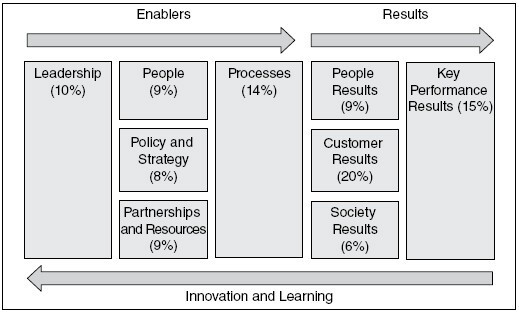
On the operational level, TQM is interpreted differently in different countries. In Europe, it is natural to interpret TQM in relation to the European Foundation for Quality Management (EFQM), which includes the EFQM Excellence Model and the European Quality Award (Hellsten & Klefsjö, 2000). As illustrated in Figure 1, the implicit EFQM definition is essentially the same as the ASQ definition, identifying TQM as a management approach to long-term success through customer satisfaction, with the additional aspect that the EFQM model makes it possible to measure the TQM maturity on a scale from 0 to 1000, based on how the nine modules within the model are given different weights. Such maturity measurements correspond with the idea that TQM is both a management approach and organisational culture that needs to be nurtured and developed.
.jpeg)
As seen in Figure 1, the EFQM model puts emphasis on leadership as an important part of TQM implementation, and governance is similarly important as seen in the focus on policy, strategy and processes, which was articulated even more explicitly as a need for governance with the 2013 update of the model. This means that applying for the European Quality Award (EQA) makes it necessary to demonstrate how TQM is implemented and maintained through use of governance and leadership.
Figure 1 also illustrates how the EFQM model emphasises employee satisfaction (9%) and society results (6%). This accommodates the idea of using Critical Systems Thinking (CST) as an ideological basis for TQM, or as Flood (1993, p. xiii) puts it:
In summary, TQM involves a lot of hard work for all, in a long-term partnership between management and workforce (and the suppliers and consumers), in a wholly new style organisation that devolves responsibility for local decisions away from management to the workforce, and emphasises operations and functions rather than positions of power.
Some might think that there is a contrast between what the quote says about delegation and distribution of power and the need for governance and leadership, and some have indeed argued that TQM in practice can become a manipulative tool used by the powerful few to control the powerless many (Steingard & Fitzgibbons, 1993), but in CST-driven TQM the intent is to use governance and leadership in support of critical awareness and emancipation, or what Flood (1993, pp. 127–143) refers to as liberation and freedom.
2.2. TQM’s need for governance
Although TQM was a popular management fashion in the 1980s, few organisations had developed sufficient governance structures to make sure that the innovations in quality control and process improvement sustained (Abrahamson, 1996; Cole, 1999). As already mentioned, the EFQM model defines governance as part of TQM, but there are different ways of providing governance. For example, if one were to follow the recommendations of ASQ (2024a) by implementing TQM through Lean Manufacturing, Micklewright (2010) suggests using ISO 9001 as a governance structure, arguing that the ISO 9001 management system is useful for making the Lean Programme sustainable while the Lean Programme helps make the ISO 9001 management system smooth and efficient. On the other hand, if the target organisation is already committed to some specific framework of corporate governance, like the OECD framework and/or has a COSO-based internal control system, it may be more effective to focus on frameworks and systems that are already in use (Øgland, 2013).
Regardless of what frameworks and structures might be in use, Flood (1993) recommends using the Viable System Model (VSM) (Beer, 1972, 1979, 1984, 1985) as means for analysing and designing the governance aspects of TQM. In his view, there are strong connections between viability and quality, arguing that the development of governance by means of VSM could be understood as “designing freedom” (Beer, 1973), as policies, rules and structure can function as an antidote to the anarchy of disorder, chaos and catastrophe (Flood, 1993, p. 131).
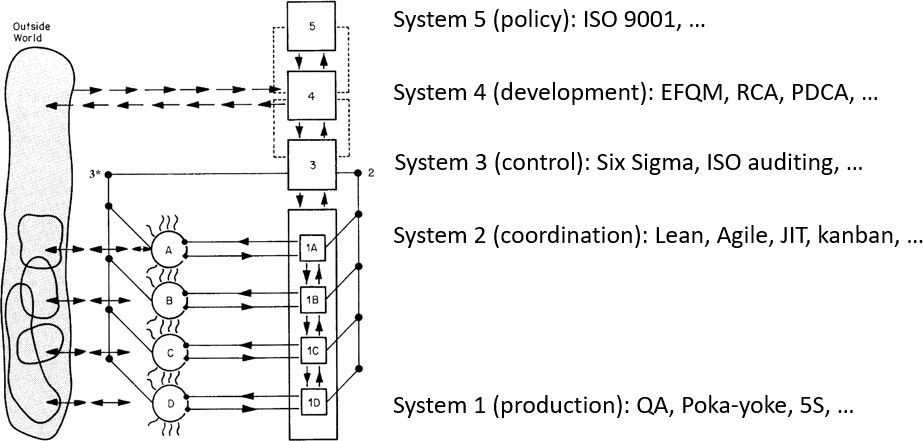
The VSM contains five subsystems sometimes referred to as production, coordination, control, development and policy (Jackson, 2000, p. 158). Flood (1993, pp. 111–118) suggests how the different aspects of TQM map onto these five subsystems, like how quality assurance (QA) and statistical process control (SPC) are important aspects of the first subsystem (production) while ISO auditing is part of the third systems (control). Akmal et al (2021) present an alternative mapping between VSM and TQM, suggesting Lean Manufacturing and Six Sigma as part of production while the remaining subsystems provide governance structure, but how to map TQM only VSM is still a question left open for further discussion. Figure 2 presents one possible map between TQM and VSM.
.jpeg)
As seen from the figure, at the production level (system 1) there should be an emphasis on error prevention in the shape of QA, fool proof working methods (poka-yoke) and ways of stimulating order, cleanness, system, standardisation and structure (5S). At the coordination level (system 2), the focus should be on coordination tools and methods like Lean, Agile, JIT and kanban systems. Quality control (system 3) comes in the shape of statistical quality control (Six Sigma) and ISO auditing. In order to anticipate the future and make improvements (system 4), the EFQM model, root cause analysis (RCA) and continuous improvement by use of plan-do-check-act (PDCA) experiments are relevant. At the policy level (system 5), commitment to quality management standards like ISO 9001 should be essential.
Despite Flood’s enthusiasm for Beer’s idea of using the VSM to design freedom, it should be noted that Beer (1984, p. 9) warns that oppressive systems can also be viable, meaning that one cannot expect that the emancipatory goals of CST will be reached by means of governance alone. Leadership is also needed.
2.3. TQM’s need for leadership
When it comes to leadership, Beckford (2002, p. 311) mirrors the EFQM position on leadership by saying that management commitment is the single most critical issue in the pursuit of quality. In the more specific case of CST-driven TQM, Flood (1993, pp. 118–125) is careful to distinguish between the type of culturally oriented leadership that fits with socio-technical systems theory and the traditional command-and-control leadership that he sees as antithetical to CST and generally incongruent with TQM.
More recently, Jackson (2024) has introduced Critical Systems Leadership (CSL) to characterise the type of leadership that is necessary for CST and thus CST-driven TQM. Based on engagement with the literature on systems leadership in general, he believes it is possible to discern seven attributes for CSL (ibid, pp. 210-211):
-
Collective leadership and collaboration
-
Communication of a vision and open dialogue
-
Co-creation
-
Attention to managing the collaboration
-
An open approach to learning
-
An ethical orientation
-
Promotion of appropriate evaluation
It is perhaps noteworthy that CSL represents a less politically radical perspective on management than what was articulated in the early CST literature, like Rosenhead’s (1987) pronouncements on how management science should be replaced with a worker’s self-management science, but there is nothing about the CSL attributes that is irrelevant for those using CST as a basis for political activism. It is important not to forget Jackson’s (1985, p. 150) earlier warnings about the need for leadership among those who live in unhealthy social environments, saying that “If those people are to be brought to the true understanding of their situation, which will enable them to regain control over their destiny, the more radical therapy of a critical social systems theory and practice is required”. In other words, when dealing with CST-driven TQM, CSL needs to be clearly executed in support of CST’s commitment to emancipation.
2.4. Summary
Despite worries about governance and leadership being misused in the hands of the powerful few to control the powerless many, which can explain why so many TQM efforts fail, even TQM literature founded in politically radical ideologies like CST emphasis the need for governance and leadership. The hypothesis of the research is thus formulated as follows:
- H1: Governance and leadership are necessary and sufficient for TQM success
The hypothesis is to be explored by contemplating a story of action researchers using VSM and CSL for creating a TQM-like environment in support of event management.
3. Methodology
There are various ways that can be used for investigating the hypothesis on TQM’s need for governance and leadership. The approach used here is action research by looking at a CST-driven TQM intervention as a field experiment (Flood, 2006; Lilja et al., 2018). In this case, the chosen intervention methodology is Critical Systems Intervention (Øgland & Evans, 2025), which is a revision of Total Systems Intervention (TSI) action research (Flood, 1993, 2006; Flood & Jackson, 1991) that makes use of the plan-do-check-act (PDCA) cycle from TQM as an overarching structure.
Flood (1993, p. 13) describes the PDCA cycle as a TQM intervention methodology that “emphasised the need for management to become actively involved in their company’s quality initiatives”. The PDCA cycle originated in Shewhart’s (1939) attempts at comparing the specification, production and inspection in mass production with the planning, execution and evaluation of scientific experiments, which Deming (1986, p. 88) referred to as the Shewhart cycle, but became known as the plan-do-check-act (PDCA) cycle in Japan and elsewhere (Ishikawa, 1985). The logic of the PDCA cycle also matches with what Kurt Lewin referred to as action research (Lilja et al., 2018):
-
Plan: Theorise the problem, and hypothesise a solution strategy
-
Do: Intervene into the problem situation
-
Check: Evaluate the outcome
-
Act: Decide whether to repeat the experiment or move on to new problem
The purpose of using PDCA as a superstructure for TSI is to make sure a particular sequence of sociological paradigms (Burrell & Morgan, 1979) is selected through the four stages, which will then allow TSI to carry out its three-part process of framing the problem by use of a metaphor associated with the given paradigm, choosing a solution method and implementing the method.
The way CSI maps the four steps of PDCA with the Burrell and Morgan classification of sociological paradigms consists of identifying “plan” with interpretivism, “do” with functionalism, “check” with radical structuralism and “act” with radical humanism. As each PDCA cycle is a continuation of a previous cycle, the default paradigm before entering the planning step is the radical humanism paradigm, where the target group is assumed to be living in a psychic prison characterised by “false consciousness”. Øgland (2023a) provides a more detailed description of CSI both as an intervention strategy and an action research approach.
4. Results
What follows is a reflection upon an action research programme on how to succeed with event management by creating a TQM-like environment through use of governance and leadership. Although the research programme started off well, producing both practical and scholarly results, it ended in failure due to challenges in governance and leadership.
4.1. Act: Deciding to do action research (Radical humanist paradigm)
Given the political nature of CST-driven TQM, it might be useful to introduce the paradigm of radical humanism by first using radical structuralism to characterise the underlying structure of political conflict by use of a game model (Gintis, 2009) and then change to radical humanism by looking at how the involved parties understand this game.
If we think of using governance and leadership as a bridge for crossing from the present state to the future state characterised by TQM success, the computer game Bridge Constructor, which consists of constructing a safe bridge within the limits of a given budget, could perhaps be used as a model. As it has been recommended as a teaching tool for engineers (Betts, 2015), perhaps it could be used as a tool for understanding how to implement TQM as well. From the viewpoint of radical structuralism, it induces a political conflict between profit and safety.
In preparing for the study on how to create Learning Destinations (TQM-like environments) through governance and leadership (Sadd et al., 2017; Sadd & Evans, 2022), the three client organisations were all in need of better ways of coordination, so they were pleased with academia trying to play the Bridge Constructor game.
Academia should make a significant contributor to the process in the form of “bridge builder” due to its historical neutrality in the context of destination management. … [Despite some scholars noticing that such bridge building is rare], the neutrality of academics remains firm with the potential to facilitate the transfer of knowledge in the context of destinations a priority for the development of policy frameworks in the context of a knowledge-based economy. (Sadd et al., 2017, p. 340)
One way of reading this quote is to say that academia should to a certain extent be able to provide the necessary governance and leadership for successful collaborate development of TQM-like environments. Also, as the client organisations were happy with this choice, from the viewpoint of radical humanism there was no need to bring people out of any type of “false consciousness” before entering the PDCA cycle.
4.2. Plan: Establishing leadership (Interpretivist paradigm)
The project started off with the aim of aiding a group of client organisations in developing Learning Destinations (aka TQM), by which was meant how to manage and develop tourist destinations in similar ways as one does with Learning Organisations (Sadd et al., 2017; Senge, 1990). In order to succeed on such a journey, it was important to create an atmosphere of mutual trust, confidence and distributed leadership, or what is sometimes called systems leadership (Jackson, 2024; Macdonald et al., 2006). The research at this stage was consequently done through the paradigm of interpretivism, using an approach not too different from the Soft Systems Methodology (SSM) (Checkland, 1981) for reaching a mutual understanding of the challenge, articulating the problem and coming up with a solution.
Although the solution presented as the Framework for the Assessment of Major Events (FAME) was the practical outcome of the research, the theoretical contribution was related to the process that resulted in the framework, namely the role of collaborative planning in the process they refer to as Destination Learning. Destination Learning was different from SSM in the sense that it made no use of systems diagrams of any kind, but the impression conveyed in the paper is still that DL was a reasonably effective approach for creating systems leadership in support of the kind of TQM-like environments (Learning Organisation; Senge, 1990) that would be necessary for effective and sustainable event management.
4.3. Do: Establishing governance (Functionalist paradigm)
The next step of implementing and testing a framework like FAME in practice would require a functionalist perspective in the sense of establishing governance structures that would provide objective evidence of how the TQM-like environment was making event management successful. It was not until the two action researchers joined up that the wider aspects of systems thinking became an explicit focus (Evans et al., 2018; Evans & Sadd, 2022), using one of the researchers’ expertise in Critical Systems Thinking (CST) and Community Operational Research (COR) as intellectual guidance. This is reflected in the way Sadd and Evans (2022, p. 36) position their research in the tradition of how Flood & Jackson (1991, pp. 96–109) have used CST for studying tourist destinations and events. At the very beginning of the paper, there is also a reference to trade union studies by Bryson et al (2004), emphasising further how the FAME implementation study aligns with the political aspects of CST and COR.
When it came to the implementation and testing of FAME, Sadd and Evans (2022) decided to make use of the Viable System Model (VSM). Although they do not explicitly define FAME as a TQM-related framework, they describe VSM as a total systems approach (ibid, p. 31) and explain how FAME is supposed to support TQM methodologies like Lean Manufacturing and Agile Development (ibid, p. 37).
The development of TQM governance structure surrounding FAME started out with the use of a Viable System Diagnosis (Sadd & Evans, 2022, p. 34), used for suggesting how the nine steps of FAME could be seen to engage with all the five subsystems of VSM. The results of this analysis were then used in the VSM design process, where the VSM model was used for describing the cybernetic structure in use by the three client organisations.
Consistent with the functionalist nature of the approach, the testing of FAME for the different organisations was objectively presented in tables, showing how they differed in maturity. For all of the organisations, some of the FAME criteria were met while there was also opportunity for improvement in trying to meet the remaining criteria.
4.4. Check: Social consequences (Radical structuralist paradigm)
When looking at the social consequences of the action research, it is useful to return to the Bridge Constructor game introduced at the beginning of the PDCA intervention, meaning a paradigm shift back to radical structuralism. Although the FAME paper (Sadd & Evans, 2022) was successful in contributing to theory while aiding the events managers in their practical work, it was only one of a string of papers prepared to document a growing practical and theoretical understanding. Using the Bridge Constructor metaphor, the action researchers were using their bridge building skills for solving practical problems while developing theoretical insights on the use of VSM and CSL, but this turned out to be insufficient, as the supporting researcher reflected (July 23rd, 2024):
That’s correct because our focus was on VSM to re-model the events management planning and delivery system. We were intending to do three follow up papers focusing on the direct impact on each of the stakeholder organisations. However, [the lead researcher] didn’t get promotion and lost interest. She has now officially retired, which is a great shame as still so much to offer the Business School.
What is interesting in the quote is not so much the reason for conflict but rather what is stated in the final sentence, namely how the lead researcher exited the Bridge Constructor game made the whole project collapse. Although it is unclear what the total consequences for the client organisations were, the role academia had been playing in terms of providing leadership and governance in development of a TQM-like environment would be gone unless someone would be willing to take over the role as project manager.
4.5. Act: The final decision (Radical humanist paradigm)
If one were to look at the situation from the radical humanist perspective of potential scholars willing and capable of taking over the project, the supporting researcher could have used Critical System Heuristics (CSH) (Ulrich, 1983) for describing the social system by way of how it was and how it ought to have been, which might have inspired him into starting a new PDCA cycle, but he had his own projects and responsibilities to take care of, so the story ends in a slight state of alienation, or at least a situation less satisfactory than it could have been.
5. Discussion
The discussion is divided into two sections. The first section discusses how the results provide evidence supporting and questioning the research hypothesis. The second section looks at explanations.
5.1. Evidence supporting and questioning the hypothesis
The hypothesis H1 was that leadership and governance are necessary and sufficient conditions for implementing TQM. In the four stages of CSI-driven action research, identified through a retrospective look at the work done by event management action researchers, we explored the hypothesis by contemplating how governance and leadership played out differently as the PDCA cycle required different perspectives and methodologies at consecutive stages. Table I summarises evidence supporting and questioning the hypothesis for each of the four stages.
The table shows evidence in support of H1 during all stages, showing how elements of leadership and governance were helpful for implementing a TQM-like environment in support of FAME-based event management. However, there are also signs of insufficient governance and leadership at all stages, particularly towards the end when internal struggles caused the collapse of the academically based governance and leadership. Although failure due to insufficient governance and leadership could be used as further evidence on how TQM implementation depends on these such factors, the fact that the collapse was outside the control of the action researchers tilts the evaluation of H1 in the direction that it was the chosen form of governance and leadership that caused TQM failure, showing TQM’s need for governance and leadership of this kind to be more fiction than fact.
5.2. Reasons for the outcome
One way of explaining the outcome is to look at the Quality Management System (QMS) in which the FAME process was embedded, focusing on how governance and leadership was expected to impact the QMS. As suggested in Table II, strong leadership without governance gives no guarantee that the QMS is actually followed while strong governance without leadership might result in a focus on non-essential issues.
In the case study, the idea was to use academia as a “bridge builder” for creating strong governance and strong leadership, using governance and leadership principles that would be consistent with TQM, corresponding with the outcome in the lower right quadrant of the table. However, when the academic bridge was about to collapse, signifying a quick shift to the upper left quadrant, there was nobody capable of preventing it from breaking down.
Interestingly, there is nothing about the general approach that seems to contradict best theories and practices. For instance, FAME was explicitly used as part of system 5 and 3 in the VSM, mirroring the recommended use of ISO 9001 when employing VSM as governance structure for TQM. Although ISO 9001 is more general than FAME, specifying a management system rather than just a nine-step procedure, in the case study one could think of FAME as a stand-in for the ISO standard, which would be very much in line with the way Sadd and Evans (2022, pp. 32–33) use VSM for analysing FAME from a systems perspective, identifying it as part of the Quality Management System (QMS).
Moreover, this example of failing despite appearing to do all the right things is not unique. It has much in common with a particular TQM implementation story from public administration (Øgland, 2013), although in such cases it is typically the governance within the client organisation rather than academia that causes failure (Øgland, 2008). In response to such failure, it has been suggested that the design and development of governance should follow a bootstrap approach that aims at cultivating and expanding the installed base of whatever may be presently working (Øgland, 2016). When using the bootstrap approach, it is important to focus on what the organisation has already committed to, just like the FAME study showed in how VSM could be used for recognizing already existing theory and practice related to lean and agility.
TQM failure due to lack of leadership, on the other hand, may typically happen due to reorganisations where people or departments committed to TQM are removed and replaced with people who have no interest or no competence, which can easily lead to disaster unless the organisation moves towards distributed leadership where teams of people take responsibility for the coordination and execution of work (Adam, 2024; Øgland, 2023b).
The idea of distributed leadership is to avoid encouraging people to follow managers and leaders mindlessly, but rather to have them develop their own intuitive way of handling problems as they arise, analogous to how Karate practitioners behave. In Karate, training consists of learning sets of behavioural patterns known as katas, so that the practitioner can competently and intuitively execute katas in response to various problems as they arise. By focusing primarily on developing practice around the PDCA cycle as a problem-solving procedure, Rother (2009) talks about “Toyota Kata”, but in Karate there is a total of 62 katas (where a black belt has to master 26 of them), so we would rather use the term Black Belt Leadership (BBL) to characterise people who have mastered a wider set of intuitive leadership skills needed by self-directed teams to survive and thrive in game-like environments of organisational politics (Cornell University, 2021).
If we look at research teams like the one responsible for the FAME study, this is an example of a self-directed team where all sorts of sophisticated leadership skills are needed in order to deal with unpredictability. Parts of this unpredictability were handled by the way one of the researchers was proficient at Karate, meaning that much of his leadership skills both within and outside of this particular project was characterised by BBL, contrasting how the other researcher, who was less skilled at BBL, decided to leave the dojo (academia) when the frustrations became overwhelming.
If there are difficulties in implementing TQM by way of the VSM in a top-down manner, due to lack of governance and leadership, BBL could be seen as a way of implementing TQM bottom-up by taking advantage of the recursive nature of VSM, seeing teams and individuals as viable systems with their own principles of governance and leadership. BBL could also be a natural way of implementing “second-order VSM” in the way hinted at in the FAME paper and more fully explained elsewhere (Øgland, 2022; Sadd & Evans, 2022, p. 42).
6. Conclusion
Total Quality Management (TQM) is a philosophy of business excellence, aiming for satisfied customers, happy employees, competitive business results and beneficial impacts on society, but it often fails for sociological, political or cultural reasons. The Critical Systems Thinking (CST) community, which looks at the world holistically from the viewpoint of the oppressed, has responded to the challenge through methodologies aiming to obtain necessary and sufficient governance and leadership for TQM success. As this approach has been criticised by those who worry that the interests of the oppressed will not be properly taken care of by the oppressors, the purpose of the study was to reflect more deeply on the paradox hidden within TQM’s need for governance and leadership.
Assuming that the CST community is right in saying that emancipatory interests can be served while accepting traditional power structures, we have looked at a CST-oriented study of how a Framework for Assessment of Major Events (FAME) needed to be embedded in a TQM-like environment (Learning Destination). However, as institutionalised governance and leadership resulted in the study being shut down prematurely, we believe higher chances of success would have resulted if the traditional approach to governance and leadership had been replaced by governance and leadership from within, illustrated by a type of autonomous situational leadership that we choose to name Black Belt Leadership (BBL).
The moral suggested by this paper is that TQM depends on governance and leadership, but to prevent unexpected collapse, governance has to build on structures and control mechanism that the organisation is already committed to, which needs to be supported by the TQM team developing autonomous situational leadership through the likes of BBL. To make sure that TQM’s need for governance and leadership is fact rather than fiction, governance and leadership must be cultivated from the bottom of the organisation rather than being oppressed from above.
Acknowledgement
We want to thank Prof. Jens Kaasbøll for helpful comments and reflections. Our gratitude also goes to the students, including Magnus Gunnarsson and Tyler Herzberg, who took part in the discussion at the end of a related lecture and added further views on the discussion list.